
Ready, Set, IND: FDA’s Fast-Track Pilot Explained
On 09/15/2026, the Food and Drug Administration (FDA) launched its Expedited Investigational New Drug (IND) Pilot Program and opened the window for sponsors to submit applications. This pilot will test whether earlier, rolling FDA review can accelerate promising drugs and biologics into first-in-human trials. Applications are due by end of October 30, 2026, and FDA expects to select around eight (8) to ten (10) sponsor qualified research institution pairs. The opportunity is real but it is not a shortcut around safety, evidence, or the final IND review [1] .
An IND is FDA’s permission pathway for testing an investigational drug or biologic in human subjects. Instead of waiting for one complete package, selected sponsors may submit complete sections during the pre-IND stage as they become ready. FDA can flag problems earlier before they delay the final filing or trigger a clinical hold post-submission.
Each sponsor must partner with a U.S. based qualified research institution (QRI), such as an academic center, health network, contract research organization (CRO), regulatory advisor, or research organization. The QRI should test the sponsor’s thinking across toxicology, clinical design, and chemistry, manufacturing, and controls (CMC). Each rolling installment must be complete and ready for review, not a rough draft or an unorganized data dump. See FDA’s program structure for details [2] as well as the diagram below, highlighting key differences between the traditional IND program and the expedited pilot.
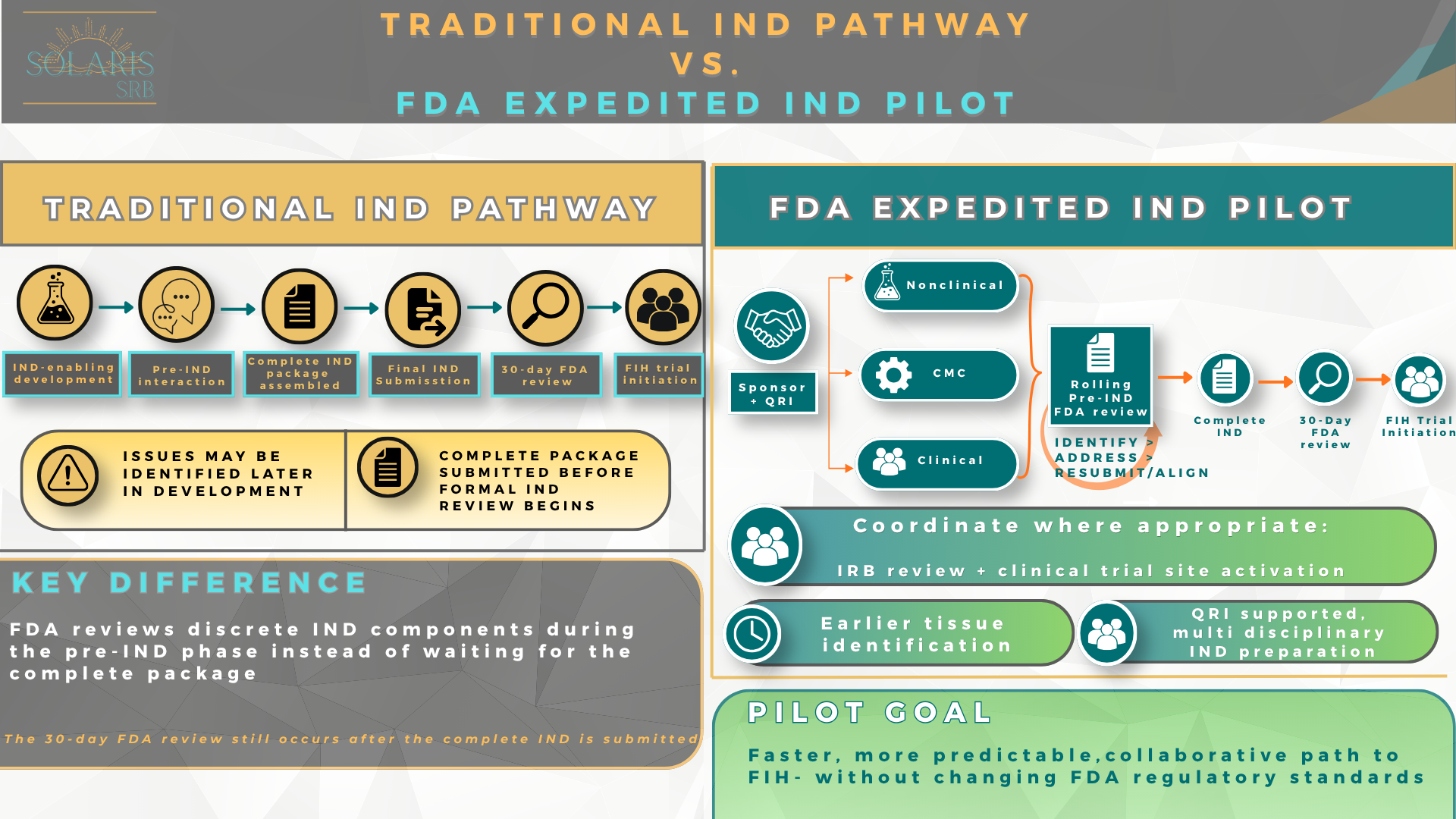
So who may qualify? The best fit is a sponsor preparing a first-in-human IND for a drug or biologic, with a capable U.S. QRI, a formal business agreement, conflict of interest safeguards, and work advanced enough to support a credible rolling plan. FDA evaluates the sponsor and QRI together.
First-in-human studies are small, closely monitored trials that explore dose, how the product behaves in the body, and early safety. The pilot does not lower that bar. Its value is timing and early agency interaction to receive feedback and questions.
Think of the pilot as earlier collaboration, not lighter regulation. Drug and biologic sponsors, including some tissue and drug combination product developers may benefit if their product will enter a first-in-human study under an IND, their evidence is mature, and their QRI can move quickly. From the FDA, sponsors should note that non-selection for the pilot will not disadvantage sponsors in any way, disqualify them from utilizing typical pre-IND meetings or other FDA interactions, nor does it imply lower-quality drug development research. Those interested should apply before the October 30, 2026 deadline!
Thanks for joining! Keep checking back as we continue following industry trends!
References